Case Study

Balance

One shared time model. Three roles. The same underlying data — visible to everyone responsible for it, in a view shaped to their responsibility.

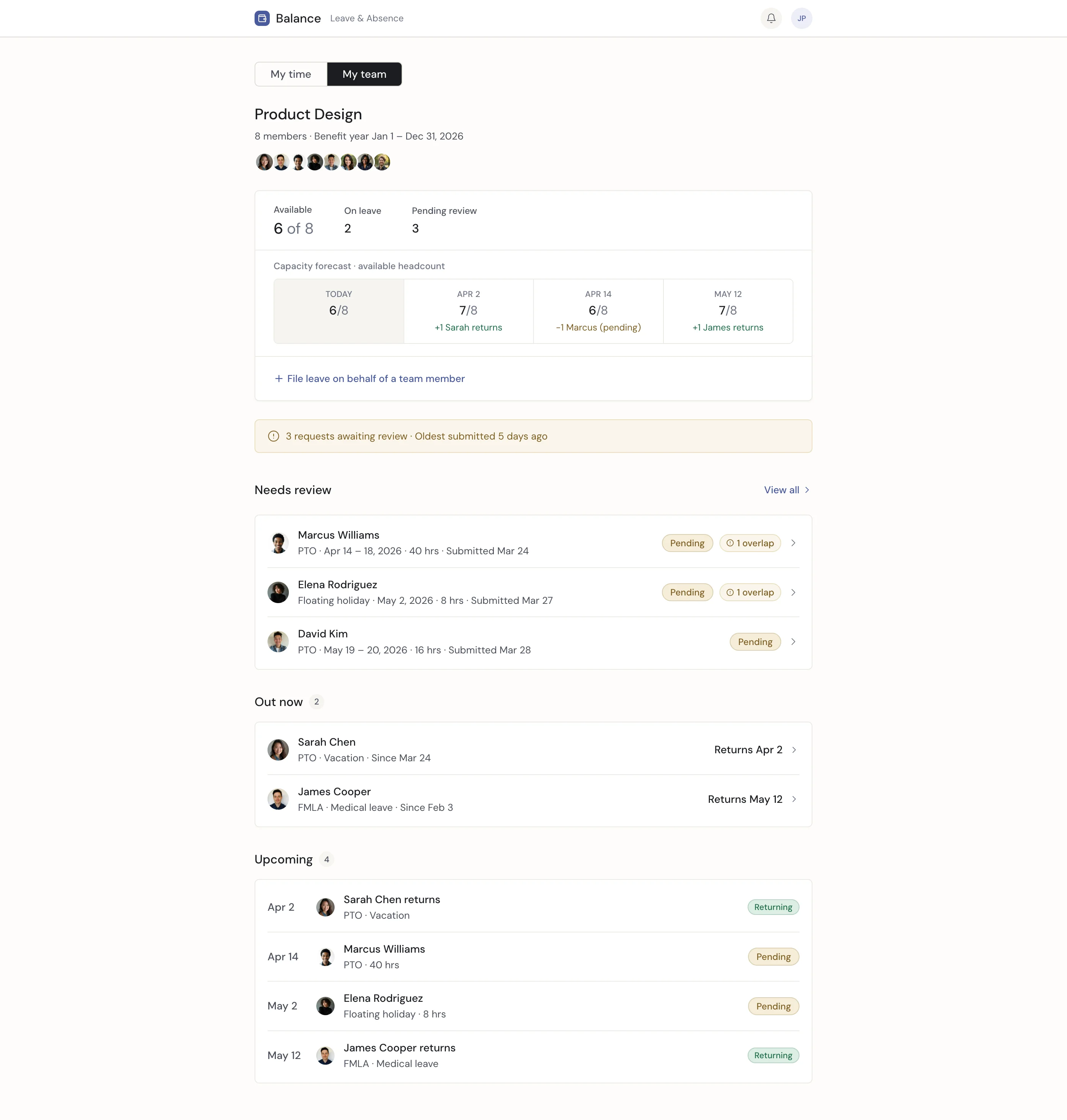
Balance manager team dashboard showing team capacity forecast, pending reviews, and upcoming absences

Manager dashboard — team capacity, pending reviews, and upcoming absences in a single view.

The platform was built for administration, but not for the people inside it. Employees couldn't answer the simplest question: what do I have? Managers approved requests without seeing what each absence meant for team coverage. Practitioners governed the organization's time one leave at a time, with no clear view across it.

Three roles, one shared resource, and no system that made time visible to the people responsible for it.

Create a shared time model that makes leave easier to track, staff, and manage across employees, managers, and practitioners. Not three separate products — one system with three entry points, each calibrated to the mental model of the person standing in it.

Give employees a time account

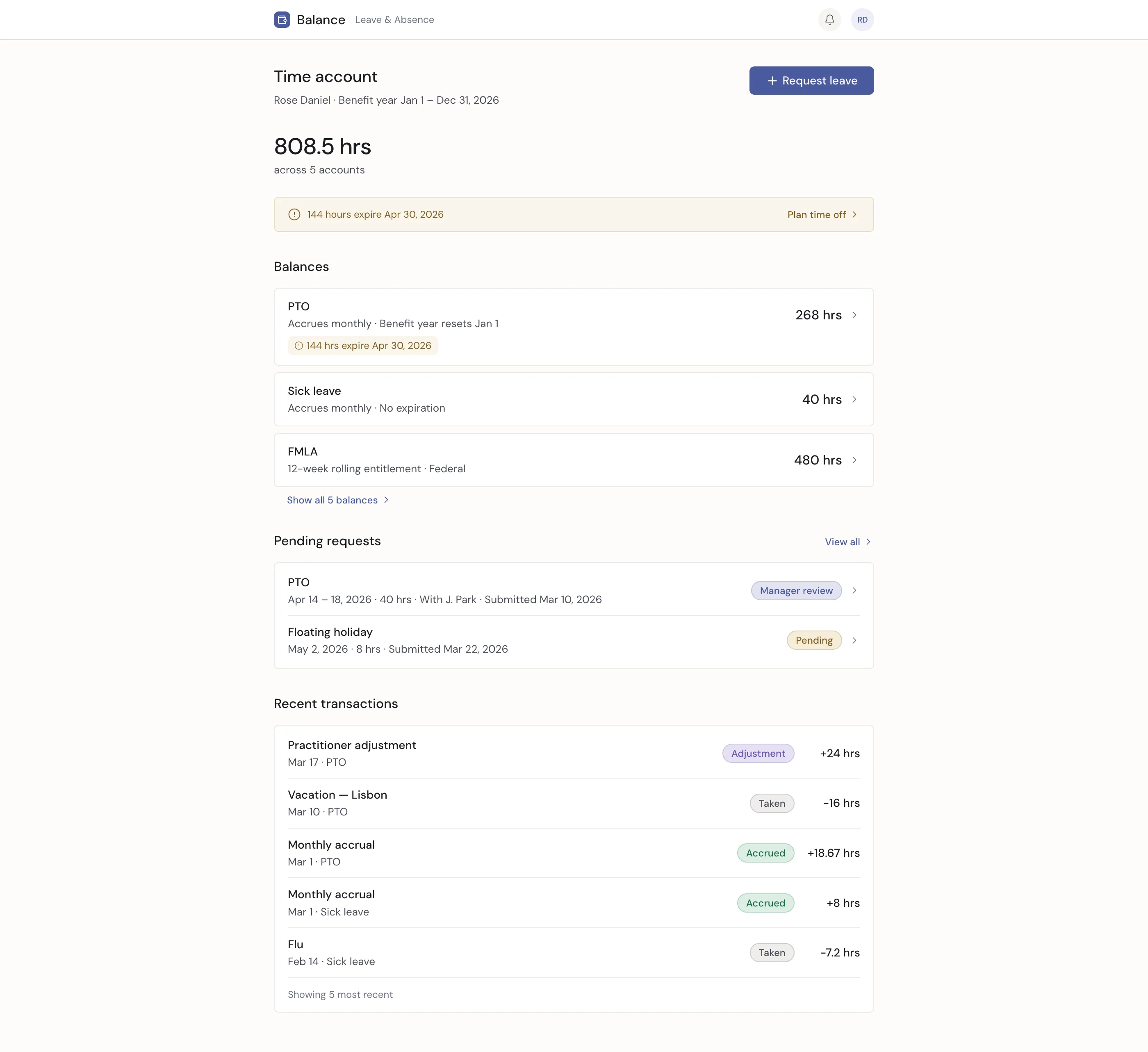
The redesign starts by making time legible. Instead of centering the experience on requests and status updates, Balance gives employees a clear account of what they have: current balance, transaction history, accruals, deductions, adjustments, and projected balance.

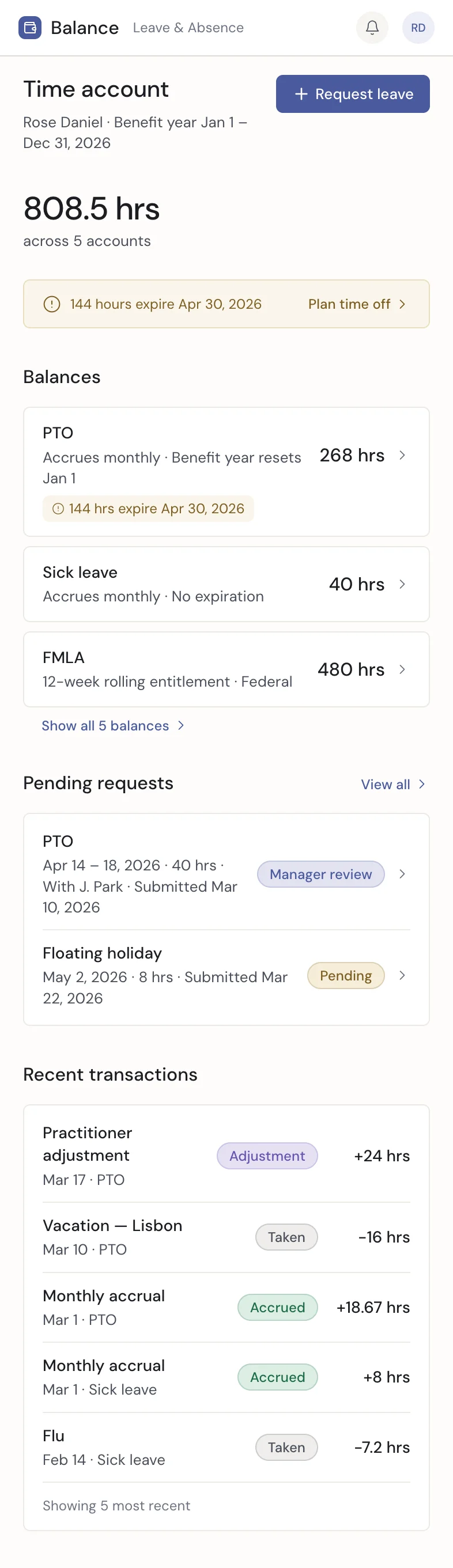
Employee time account showing 808.5 hours across 5 leave accounts, with balances, pending requests, and recent transactions Employee time account on mobile

Time as a currency. Balance, accruals, and transaction history give people a clearer way to budget their time.

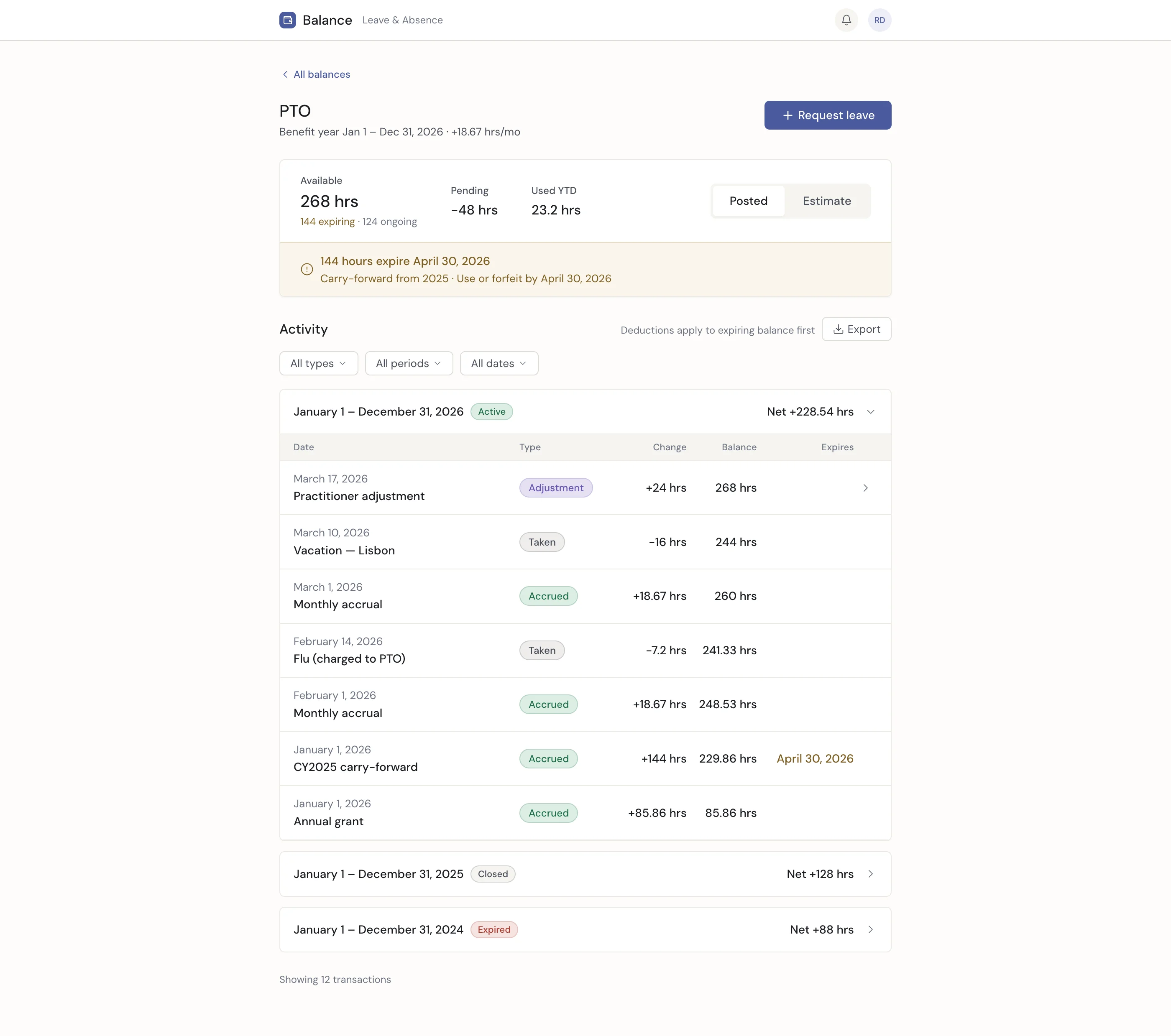
Make the ledger readable

The employee view shifts the core question from "Did my request go through?" to "What do I have, and what will I have next?" Accruals work like earned interest. The ledger works like a readable summary of what changed and why.

PTO posted activity ledger showing transaction history with accruals, adjustments, and usage across benefit periods PTO posted ledger on mobile

Posted activity — a readable record of accruals, adjustments, and usage.

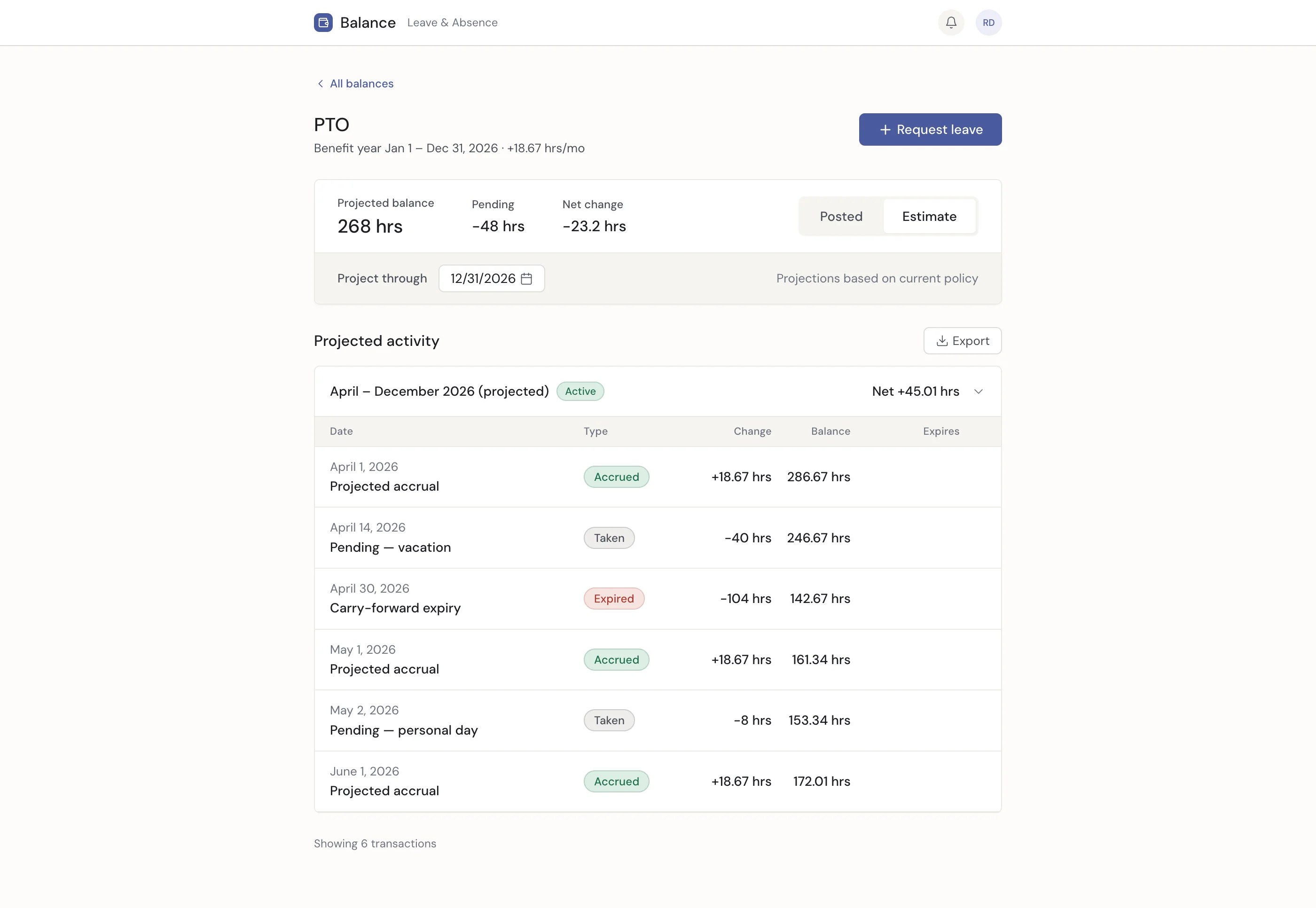
PTO estimate view showing projected activity through a future date with projected accruals, pending requests, and carry-forward expiry PTO estimate view on mobile

Estimate view — projected accruals, pending requests, and carry-forward expiry.

Help managers see the team

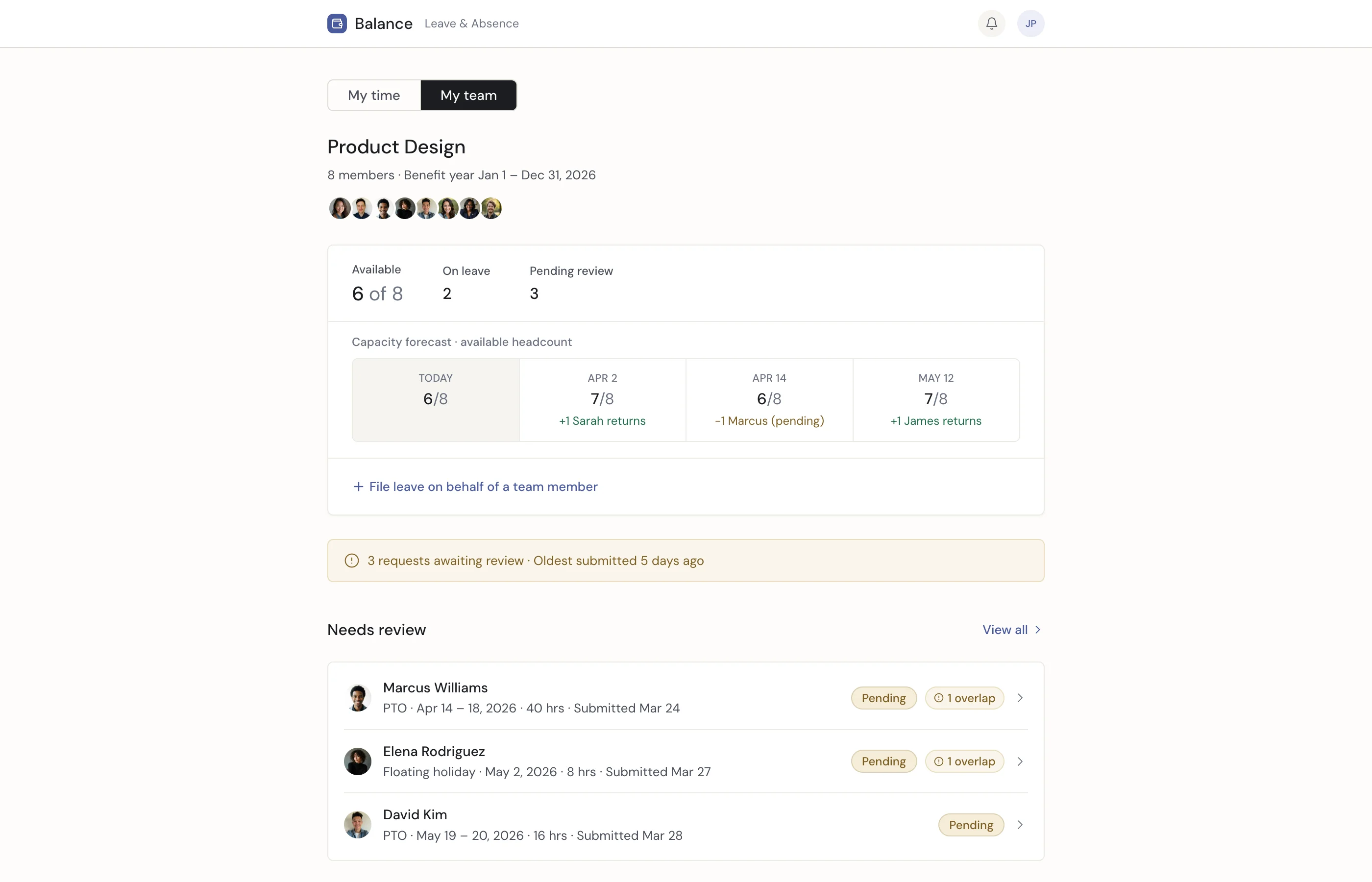
Managers were being asked to approve leave without enough context. Balance gives them a team view of who is out, who is returning, what is pending, and what it means for coverage.

Employees use Balance to budget time. Managers use it to budget coverage.

Manager team dashboard showing 8 members, capacity forecast, pending reviews with coverage overlap flags, current absences, and upcoming returns

Team dashboard — capacity forecast, pending reviews, current absences, and upcoming returns.

Review with context

The manager view shows how leave affects team coverage, so managers can approve requests with a clearer view of scheduling impact and resourcing needs. Routine approvals happen from a single notification. When a request exceeds manager authority, the system routes it and explains why.

Expanded leave request review showing balance after approval, team capacity context, and daily scheduling impact visualization

Expanded review — balance impact, team capacity, and scheduling context at the point of decision.

File on behalf

Filing leave on behalf of a direct report becomes a clear path, not a workaround. The three-step flow shows available balance, reviews the impact, and confirms submission.

File leave on behalf form showing team member, leave type, available balance, date and time fields
01File on behalf
Review and file confirmation showing leave details, balance impact, and team capacity context
02Review and file
Leave filed confirmation showing the request has been submitted and team member notified
03Confirmation

Give practitioners an organizational view

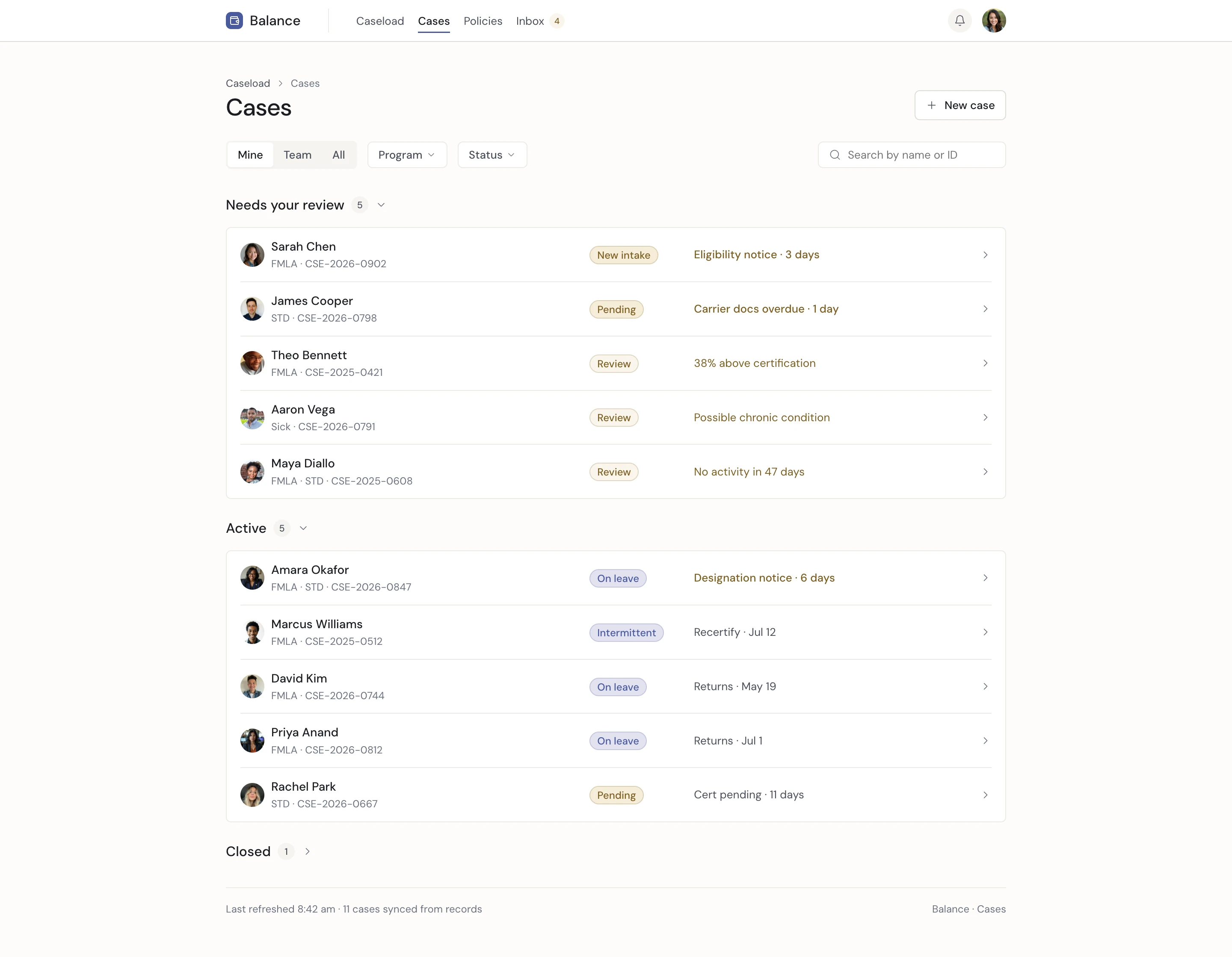
Practitioners needed to see across the organization, not one request at a time. Balance gives them visibility into aging requests, pending adjustments, and exceptions that exceed manager authority. Instead of searching through cases to find what needs attention, they can see where action is needed and respond from a clearer operational view.

Preserve the language of the domain

The design does not flatten leave into generic language. Terms like FMLA, STD, PFL, Ziektewet, and WAO remain intact, with contextual definitions available when needed. In compliance-heavy systems, over-simplifying domain language creates distance between the product and the people responsible for using it well.

Respect attention

Visibility alone was not enough. Timing mattered too. Balance introduced a daily digest for managers, sent only when something changed. Pending requests come first, then coverage, then capacity. If the manager cannot understand what needs attention quickly, the system is adding work instead of reducing it.

Balance reorganized the platform around time instead of forms.

Employees gained a usable time account they could plan around. Managers gained a team view that made staffing impact visible during approval. Practitioners gained an organizational view that surfaced where action was needed. Three roles could now work from the same underlying model, each with a view shaped to its responsibility.

What had been fragmented across requests, approvals, and case-by-case oversight became a clearer operating model for leave. The time account pattern, shared time model, and notification logic also created reusable components across the broader leave product line.

The governing principle throughout was Gentle Attention — anticipation as care. The system surfaces what you need before you know you need it, then steps back. For a practitioner managing aging requests and compliance flags across an organization, getting the right signal at the right moment is not a UX convenience. It is the product.

For any product navigating the problem of breadth without legibility — where power creates configuration complexity and no role feels fully served — Balance is a demonstration that it is solvable. One underlying model. Three surfaces. Each shaped to the person using it.

Cross-regional leave policy is genuinely complex. Dutch social insurance models, US patchwork law, and LatAm regulatory variation operate by different rules. Most HR designers have never left one country's policy model. The research foundation for Balance mapped workflows across all of them.

15+ SME interviews across the Netherlands and Americas
3 Personas — employee, manager, practitioner
2 Regions — cross-regional compliance
  • Start with the resource, not the transaction.
  • Give employees a way to budget time.
  • Give managers a way to budget coverage.
  • Show what needs attention across the organization.
  • Make leave easier to track, staff, and manage.